
Lawmakers reportedly stunned to learn sportsbooks prefer customers who continue losing money
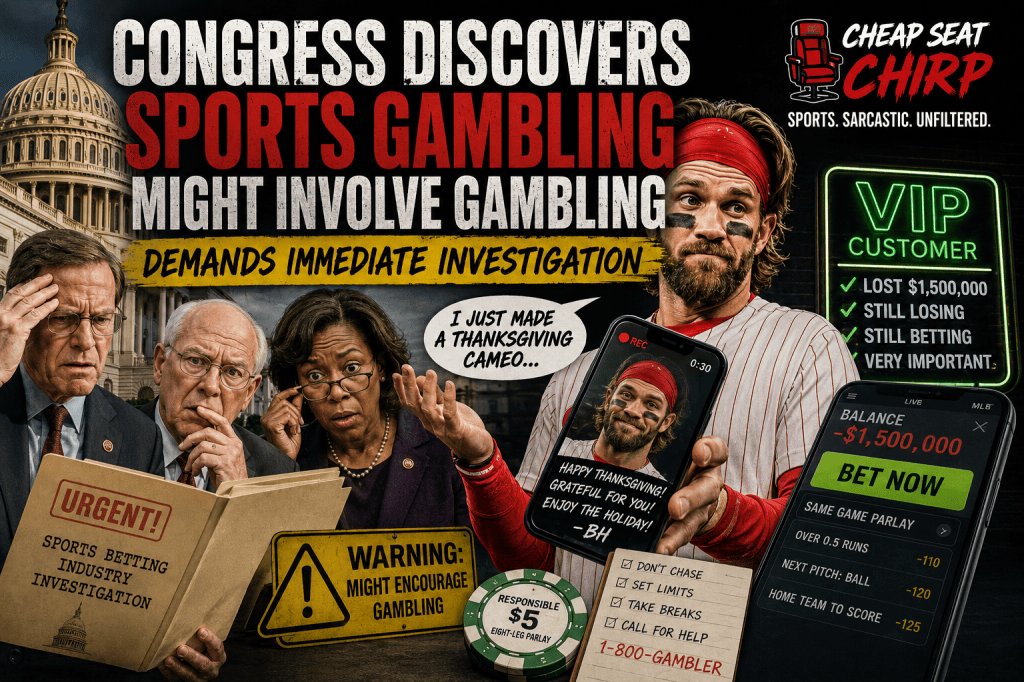
WASHINGTON — In a stunning development Monday, several members of Congress discovered that the multibillion-dollar sports gambling industry may occasionally encourage people to gamble.
The revelation came after reports that FanDuel sent a personalized video featuring Philadelphia baseball star Bryce Harper to a VIP customer who says he was struggling with a gambling addiction and had lost approximately $1.5 million.
Congress responded swiftly, presumably immediately after closing the seventeen FanDuel pop-ups required to read the original story.
Sen. Richard Blumenthal and Reps. Paul Tonko and Valerie Foushee sent letters demanding answers from Major League Baseball, the players union and FanDuel about the relationship between professional sports and gambling companies.
Sources inside Washington confirmed lawmakers were particularly alarmed to discover that the term “VIP customer” at a sportsbook does not necessarily mean the customer is exceptionally talented at sports betting.
“This changes everything,” said nobody we actually interviewed.
According to reports, Harper recorded a personalized message in 2024 that eventually reached the FanDuel customer. Harper has said he didn’t know how FanDuel intended to use the video, and reporting has found no evidence that he knew the recipient had a gambling problem.
Which puts Harper in the somewhat unusual position of being dragged into a national gambling controversy for essentially recording the world’s most expensive Thanksgiving Cameo.
FanDuel’s alleged strategy apparently went something like this:
Step 1: Find customer who has wagered enormous amounts of money.
Step 2: Customer continues losing enormous amounts of money.
Step 3: Label customer “VIP.”
Step 4: Send personalized message from famous athlete.
Step 5: Absolutely nobody asks whether Steps 1 through 4 look fucking insane when written down.
The controversy has now prompted lawmakers to call for MLB and the players union to prohibit players from promotional arrangements with sportsbooks.
This represents a dramatic philosophical shift for professional sports, which has spent the better part of the last decade carefully constructing a gambling ecosystem sophisticated enough that a viewer can watch a pitcher throw Ball 2 and immediately receive an advertisement inviting him to financially speculate on Ball 3.
Major League Baseball has long maintained strict rules protecting the integrity of the game.
Unless, apparently, we’re talking about the commercial break.
Fans watching at home can currently experience America’s pastime the way Abner Doubleday presumably envisioned it:
Single.
BET THE NEXT RUN.
Pitching change.
BUILD A SAME-GAME PARLAY.
Home run.
GET $200 IN BONUS BETS.
Call to the bullpen.
LIVE ODDS HAVE CHANGED.
*Concerned about your gambling? Call the number appearing underneath the advertisement encouraging you to gamble.
Congress now appears concerned that the relationship between professional sports and sportsbooks has become too cozy.
This revelation reportedly shocked everyone except anyone who has watched a professional sporting event during the last five years.
The leagues insist that gambling partnerships can coexist responsibly with professional sports.
Sportsbooks insist they promote responsible gambling.
Broadcasters insist gambling advertisements have become an important part of the viewing experience.
And fans insist they’d occasionally like to know what the fucking score is.
Harper, meanwhile, appears to have accomplished something considerably more difficult than hitting a 100-mph fastball:
He became the face of a sports-gambling controversy without apparently knowing he was participating in the sports-gambling promotion that caused it.
That may ultimately make him the most relatable person involved.
Because somewhere between professional leagues partnering with sportsbooks, broadcasters displaying live odds, teams signing gambling sponsorships, athletes appearing in promotional content, and Congress suddenly wondering whether all of this might encourage gambling, the American sports fan is left asking one simple question:
Wait. Who exactly did everyone think was paying for all those bonus bets?
Cheap Seat Chirp will continue investigating this developing story immediately after placing a responsible $5 eight-leg parlay that absolutely cannot lose.


Leave a comment