
Owners want financial consequences for players injured doing more than 100 off-field activities. Somehow, scooters still aren’t one of them.
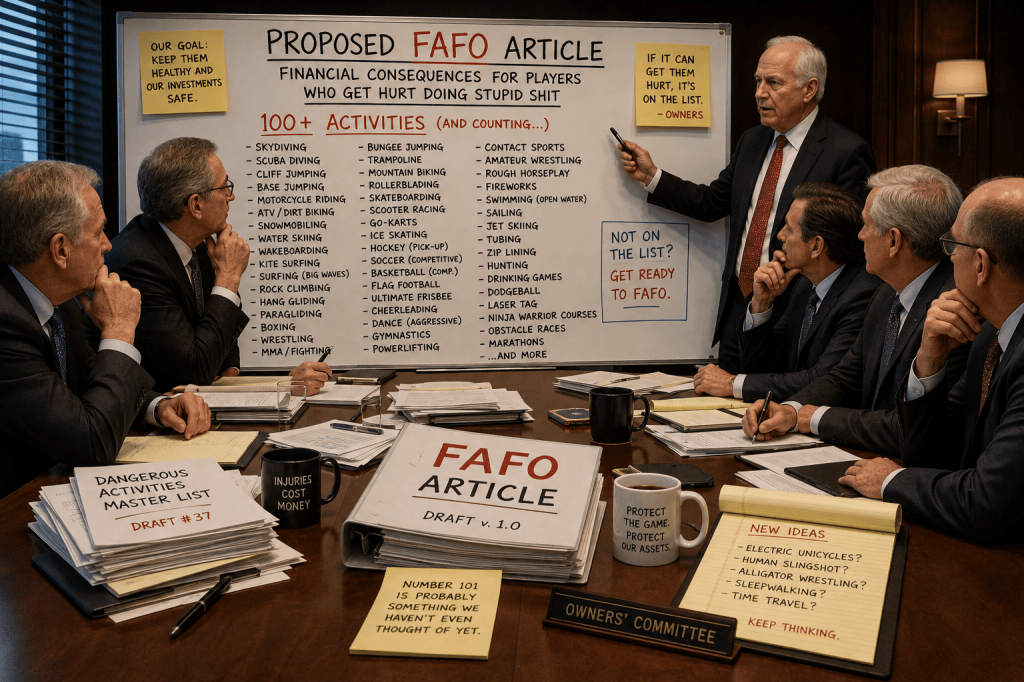
Major League Baseball owners have apparently spent part of the upcoming labor negotiations tackling one of the most pressing problems facing America’s pastime: What if a baseball player does literally anything?
According to reporting surrounding the league’s upcoming collective bargaining negotiations, owners have proposed a list of more than 100 activities for which players could potentially face financial consequences if they get hurt participating in them. More than 100. That’s not a prohibited-activities clause; that’s the terms and conditions for an Apple software update.
Somewhere, a group of extremely expensive attorneys apparently sat around a conference table trying to anticipate every possible way a professional baseball player could injure himself while away from the ballpark. Skydiving? Put it on there. Skiing? Obviously. Motorcycle racing? Absolutely. Competitive sports outside baseball? We can’t have that. Whatever activity number 73 is? Fuck it. Put that on there too.
By the time they crossed 100, somebody in the room presumably asked whether they should just write: “Player agrees to remain wrapped in bubble wrap inside a climate-controlled storage facility whenever not actively participating in a baseball game.”
The bizarre issue has received renewed attention because San Francisco Giants outfielder Harrison Bader managed to discover a loophole in baseball’s apparently extensive catalogue of ways to hurt yourself: a scooter.
Bader had already been sidelined with plantar fasciitis when he was involved in a late-night scooter accident in San Francisco on July 26. The accident aggravated his injured left foot and delayed his return to baseball. The Giants subsequently suspended payment of Bader’s salary while investigating the circumstances of the accident, which is significant because Bader signed a two-year, $20.5 million contract with San Francisco.
Most people who crash a scooter wake up the next morning with road rash, a cracked phone and an Uber receipt they don’t remember. Harrison Bader potentially woke up considerably poorer.
And here’s where things get wonderfully stupid. Baseball already has rules governing dangerous activities. The standard player contract contained in the current collective bargaining agreement prohibits players from participating in activities including automobile racing, motorcycle racing, skydiving and skiing, along with boxing, wrestling and other competitive sports.
The owners apparently looked at that and decided: Not nearly specific enough.
So, ahead of negotiations for the next labor agreement, they reportedly produced the mother of all “Don’t Do Dumb Shit” lists — more than 100 activities that could potentially result in financial consequences when an injury occurs.
Except scooters aren’t on it. Neither are electric bicycles.
Which means Major League Baseball’s lawyers apparently successfully imagined more than 100 ways for an athlete to get hurt and still got beaten by something available for rent outside a Buffalo Wild Wings. That’s impressive. It’s the legal equivalent of building a 30-foot wall around your house and then realizing you forgot to install a front door.
Scooters aren’t exactly some obscure new technology, either. Players use them in major-league cities because they’re convenient transportation around downtown ballparks. They’re cheap, they’re everywhere, and unlike driving, you don’t spend 45 minutes sitting in traffic wondering whether humanity was a mistake. Detroit Tigers closer Kenley Jansen is among the players who reportedly use scooters, and the players’ general argument isn’t particularly unreasonable: If you ride one responsibly, what’s the problem?
Unfortunately, professional athletes have spent roughly the entire history of professional sports demonstrating why the phrase “if you do it responsibly” eventually ends with an insurance adjuster rubbing his temples.
Former major-league pitcher Ben Lively learned that lesson in 2018. While pitching in Triple-A for the Philadelphia Phillies organization, Lively rode a hoverboard before a game in Buffalo. The hoverboard hit a hole, Lively went flying, and he dislocated his right collarbone. He missed two months and later acknowledged how stupid the whole thing was.
Baseball players are elite athletes capable of tracking a 98-mph fastball, hitting a moving baseball approximately 400 feet and making split-second decisions under enormous pressure. Then you give one a hoverboard and suddenly he’s your uncle trying out the kids’ Christmas presents after three bourbons.
Which explains why owners want protections. Teams invest tens — sometimes hundreds — of millions of dollars in players. If your $200 million pitcher tears his elbow throwing a slider, that’s baseball. If he tears it attempting a backflip off a Sea-Doo while holding a Roman candle, the general manager is going to have some follow-up questions.
The problem is trying to legislate stupidity comprehensively. You can’t. Human beings are innovative. Write down 100 dangerous activities and someone will invent number 101 by Thursday. Ban motorcycles and someone buys an electric unicycle. Ban skydiving and somebody discovers wingsuits. Ban skiing and a rookie will separate his shoulder riding a cafeteria tray down a hotel staircase.
Eventually the prohibited-activities section of the collective bargaining agreement will just read:
ARTICLE XXIII — FUCKING AROUND
Section 1: Don’t.
Section 2: If you do, and subsequently find out, salary protections may not apply.
That would save everybody approximately 40 pages.
And baseball could use the space. The current collective bargaining agreement already runs hundreds of pages, governing everything from salaries and free agency to roster rules, benefits and working conditions. Now owners and players are heading toward negotiations over the agreement that will govern the sport beyond 2026, with considerably larger issues already sitting on the table: salary caps, salary floors, minimum salaries, free agency, revenue sharing and contract lengths.
You know — tiny little questions concerning billions of dollars and the entire economic structure of Major League Baseball.
And somewhere among them: Can Kyle from the bullpen ride a Lime scooter to Chipotle?
Apparently, we’re going to need an answer.
The owners’ desire to protect their investments makes perfect sense. So does the players’ reluctance to have their employers dictate every recreational activity they can participate in during their personal lives. Finding the line between those two interests is precisely the kind of thing collective bargaining is supposed to accomplish.
But if MLB genuinely intends to enumerate every dangerous activity available to a professional athlete, it should probably abandon the 100-item approach now, because Harrison Bader already demonstrated the fatal flaw. You can spend months identifying every conceivable threat to a player’s health. You can hire lawyers, negotiate definitions, draft more than 100 prohibited activities and create one of the most comprehensive contractual collections of “Don’t Do Dumb Shit” ever assembled.
And then one of your players will climb onto a rental scooter late at night and discover number 101.


Leave a comment